A couple of years ago, in my quest reading all of Agatha Christie's work, I stumbled upon a recent reprint of an old collaborative book. Written in 1931, The Floating Admiral was devised by the members of The Detection Club, a 'fun' society whose members included the likes of Agatha, Dorothy L Sayers, GK Chesterton and many many others since. Presumably the reprint was a success as now a second Detection Club novel has been reprinted by HarperCollins, and I've just finished it.
The Floating Admiral was one of the first published collaborations between a group of professional, published authors, and even today it's quite star studded. There's fourteen writers involved, writing a chapter of a detective story each. Naturally, the story suffers - you can't compare it to a typical crime tale, even if the plot has all the hallmarks of one. A body is found murdered, floating on a boat on a river mouth between two towns! Not only is there suspects and alibis and tracing his movements, but also remarks about the tide and how to moor boats!
The style jumps around with each author, especially with the addition of more clues and twists, but it's kept from getting too contrived by an ingenious instruction: each writer, as well as acknowledging everything that came up before, had to come up with a solution to their chapter (printed at the end of the story), their own explanation of the evidence. Agatha Christie, whose short chapter thankfully has a lot of typically good dialogue between characters, came up with a famously great explanation, which I won't spoil here.
It's a very interesting book, and a fun experiment for the Club (they had worked together on a couple of short serialisations before this, but not a full length novel). Many of the writers have faded into obscurity (especially the most florid named such as Canon Victor Whitechurch and Edgar Jepson), so the introduction putting them into context is much needed. The book itself, though, is an odd read. What starts off as atmospheric and scene setting, quickly descends into a mess of overly complex evidence, deduction and counter deduction. The task of the final writer to tie everything up must have been enormous - but I'd prefer something less technical, playing on the fact each chapter has a different author by having a change in style, rather than juggling the plot all of the time. It's skilfully written though, definitely grabbing your attention, and definitely living up to the concept.
Ask a Policeman, the following collaboration, seems to tackle the inherent problems of the first book head on. For starters, it has only half the number of authors than the first book, making it a smoother, slightly more coherent affair. And secondly, this time they bring along their detectives!
The four detectives were probably well known to readers of detective fiction in 1934, but less so now. Whilst I'm familiar with the enthusiastic (and often infuriating) Lord
Peter Wimsey from Dorothy L Sayers, and I've heard of Gladys Mitchell's
Mrs Bradley (played by Diana Rigg later on TV, and I've got one on my
reading pile), the other two I hadn't heard of before. The trouble is that these books are barely in print at the moment, especially Helen Simpson's stage manager Sir John Samaurez and Anthony Berkeley's Roger Sheringham, who, whilst having books adapted into films by Hitchcock (!), remain obscure. Not to mention the other two authors involved in this (and the previous book too), John Rhode and Milward Kennedy. This means it's sometimes hard to see the humour and parody involved when they appear, but they're good characters and very good writers.
In fact, the book itself is marketed under Agatha Christie - and unlike The Floating Admiral, she hasn't even contributed to this one! Rather, they've lumped in a Preface that was published elsewhere, an essay by her about other Detective Fiction writers. However it's a great piece - insightful and critical - and fits this book very well.
It's rather a shame that some of the writers aren't better known, because it's a good read! This book has an odd gimmick - one writer, Rhode, writes the set-up this time, putting in an impossible amount of clues into his relatively short opening. That it stands up to the later repeated scrutiny, and doesn't get too dull when it's explained again and again, shows his merits. (The plot itself is possibly stereotypical, and definitely contrived, with three important pillars of society being involved and suspected in a country house shooting!). Whilst it's all about alibis and timings, the initial chapter is so open, the following chapters are all quite different.
The next four writers each have detectives 'solve' the case - but in a gimmick designed to invoke parody, they swap detectives and are writing in somebody else's style. This doesn't entirely work without knowledge of the originals, but it's put to the background. More important are the deductions, and there's a lot of them. Whilst some of these are long winded or with overly flowery prose, they're different enough to keep holding your attention, especially in small doses. By the end of it though, you know the movements of everybody at Hursley Lodge like the back of your hand, it's been reiterated and debated so many times.
And then, tying up everything in a very fun and ingenious final chapter is Milward Kennedy. The clever conceit is that all of these detectives, whilst their chapters were written independently, worked around each other, and every clue they found was correct - even if they picked different suspects as the murderer. So who really did it? A fifth solution is found, that's meant to be the 'correct' one that fits almost all of the evidence. It sounds horrendous to write, making sense of every clue (and sneakily discounting a couple of murderer's confessions!) but thankfully it's painless to read.
Both of the books are less coherent and less readable than usual detective novels, but then they don't claim to be. Rather, through parody and wit, they enthusiastically push some of the conventions of the genre, in an era where detective fiction was all the rage. These books are better than the concept sounds, and well worth discovering now they've been reprinted once more (in very smart new editions!), and the talent involved means they shouldn't be overlooked in a hurry. Whether any more of the few Detection Club collaborations will be republished, without Agatha Christie's name attached, remains to be seen, but I hope so, if they match this standard.
Showing posts with label agatha christie. Show all posts
4 Apr 2014
24 Jan 2013
Agatha Christie's Autobiography - a review
After reading almost all of her canon of work, I've delved into one of Agatha Christie's most important tomes - her autobiography. Though published in the months after her death, it covered her life up to when she was in her seventies, about ten years before she died. Whilst I was reading and discovering her books, I'd built up a strong image of who she was - by what subjects she wrote about, or information regarding the publishing of her books, or that famous disappearance - and even some particularly autobiographical characters she created. So, how would I find reading this, her own, perhaps definitive, account of an eventful life?
The book is a long one - it weighs in at 250,000 words, and took her fifteen years to complete it. But the extra time was worth it, as it's packed full of interesting stories and happenings. And whilst there are digressions along the way, it has all the economy - and excitement - of one of her great books.
People who are expecting a complete guide of every process that goes into writing one of her novels are going to be disappointed - it's an autobiography after all, a personal account of the story of her life. The books rarely feature - and when they do, they're the ones that she considers important personally, or that she has strong memories of, or has picked out as a good book when reading back many years later. There's particularly a fair amount about how she came to write her first book, The Mysterious Affair at Styles, and also the publishing side of things.
It's interesting to read how at first Agatha Christie didn't consider herself as a novel writer, but as a wife who started to do that sort of thing on the side to make some extra money. Ten years on, and she found herself writing books even when she didn't want to - a sign, for her, that it was now a job, and she would write a book every year. There are recollections of crafting some of her early work - the light hearted adventure type thrillers "that are more fun, and quicker to write", yet few of the period in the 1930s in which some of her most acclaimed detective stories were published. However, she also delves into other parts of her work (such as poems, short stories, romantic novels and acclaimed plays) and interestingly, her thoughts on the process of writing, and how she came to do it in the first place. Written in the first person, she shares a lot of personal opinions, and it builds up a picture of her own character - and in one frank section, she simply gives us a list of things she likes and things she doesn't!
Rather, the avid Agatha Christie reader gets a sense of the time she was living in, and the wider world in which her books were written in - a time of country houses, servants, generations of men becoming soldiers, and unexpected foreign travels. It's easy to forget that some of the events she describes happened over a hundred years ago.
After a slow start, though with many detailed recollections of her early years - no less busy than her later ones, as her parents moved around France as she was growing up - she then covers the events of her reaching adulthood, with plenty of prospective husbands! Personally, I found the book picked up pace, despite the many amusing and heartfelt events of her childhood - and became even more interesting when it went on to cover the events of the First World War, and the interesting world of the VADs, and events that would strongly shape her future.
The book, and by extension her own life, covers a lot of ground - from schooling, to nursing, to travelling round the world - and is often a joy to read. Her books are often praised for their readability, and this one is just the same. Despite the length, it's accessible, enjoyable and moving - giving us an insight into the modest, retiring crime writer, whose audience - including me - previously only knew through her detective novels.
30 Nov 2012
Akhnaton - a play by Agatha Christie
As you might expect from the striking front cover and title, this is something a bit different. In fact, I'd probably never read it if it wasn't for Agatha-Christie-devouring completeness.
It's a historical play (so not a murder mystery) set in Ancient Egypt. It's never been properly performed however (though she must have liked it to want it published), and has 'little commercial value', apparently. Which I read as code for being 'utterly boring'.
But whilst it's not boring, it is a bit dry. You don't need too much background knowledge when reading it - entry level Egyptology will suffice' - but the play concerns the reign of the pharoah Akhnaton (whose wife Neferiti was probably more famous, as was his successor Tutankhamun), and his subsequent downfall. The play wobbles between historical background and research (names of gods, practices, lineage and castes, especially apparent in long speeches) with typical human drama and emotion (idle talk between townsfolk, many of the characters' conversations). It's melodramatic, and more highbrow than your usual fare.
But altogether, it hangs together quite nicely. For its big scale and subject matter (there's many sets and costumes, and always talk of far off rebellion) it wrings every bit of human drama out of the royal court, with the mad king (which felt a bit Shakespearean, but it works), his right-hand-man, and plots against him by priests and saboteurs. He was the king who shook off using multiple religious gods, instead reverting to one, represented by the sun. Agatha paints him as young, artistic and peace loving, ambitious but weak and misguided, and ultimately very very mad. So that's fairly hard to warm to, when your main character goes off on one at the end of the scene.
Whilst it's nowhere near the usual Agatha Christie in subject matter (despite her referring to history and archaeology many times), somehow in places characters end up talking very much like Agatha Christie characters, circa 1937 when it was written (seriously, the discussions about the nature of art could come straight from Five Little Pigs or The Hollow).
Its main feat is creating an actual readable (or performable) play out of such a sparse, yet rich, strain of history. It's worth noting that, as it was written in 1937, much of the historical 'accuracy' has been disproved by now, or even by 1973 when the book was published. It was only written fifteen years after Howard Carter discovered Tutankhamun's tomb. However, given the historically dry subject matter, to experts and non-experts alike, her later Ancient Egyptian murder mystery Death Comes As The End is probably a safer, more mainstream choice.
25 Nov 2012
The Novels of Agatha Christie
About four years ago, I decided to read some Agatha Christie. I'm not entirely sure why - I'd not seen any on the telly, so it was probably because of Doctor Who. I started with the perennial 'The Murder of Roger Ackroyd', and then 'Death on the Nile', and before I knew it I had made a pledge to consume the entire back catalogue, through the help of my local libraries. All eighty or so books!
So in this post, I'm going to guide you through the highlights and highpoints - mostly the classics you might have heard of, but they're classics for good reason. This is probably a list of some of the best things she's written - unlike Sherlock Holmes, say, her novels are far better than the short stories.
The novels broadly divide themselves into three categories - the ones starring Poirot, the Miss Marple mysteries - her two most prolific detectives - and the 'other' category, of which there are many. Not all of these are murder mysteries - there's also some brilliant thrillers, as well as delving into the romantic and supernatural,
A word of advice if you're picking books off the shelf - broadly speaking, 'vintage' Christie tends to be stories written around 1930 (her early twenties work take a while to hit their peak) to 1950 (in the novels of the late 60s and into the 70s, written in the last years of her life, the standard of writing and plotting has noticeably slipped). And if you remember the TV (or film) adaptations beforehand then, in most cases, don't bother reading! Honestly, you'll enjoy them far, far more if you don't know what's going to happen next.
The Hercule Poirot novels
In my opinion, the best of the bunch - I prefer Poirot stories to Marple, if only because they contain some of her most ingenious set-ups. Poirot was the first detective she came up with - and, together with friend and narrator Captain Hastings - is basically Sherlock Holmes... but Belgian! Whilst early stories deal with many Holmesian ideas - Inspector Japp takes on the beleagured police role, there's a wife for Hastings, even an Irene Adler figure - he soon grows out of his trappings into something much greater. So - which are my favourites?
The Mysterious Affair at Styles
Her first novel, written as a bet, and designed to be surprising and unsolvable, yet all the clues are before us. You could do a lot worse than this, a fine country house mystery. (Poirot returns to the house of Styles in his last (chronologically) story, 'Curtain'. But that's a whole other novel.)
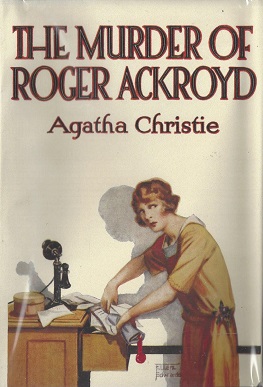
The Murder of Roger Ackroyd
Controversial, ingenious, and probably not the best choice for a first dip into Christie - although it is one of her very best. I'll say no more!
Murder on the Orient Express
Infamous, especially the ending - but if, like me, you don't know who did it, it's a perfect chance to dip into Poirot's most famous adventure. There's lots of atmosphere created by the isolated setting of the train, and the investigation is methodical and ever intriguing...

The ABC Murders
Another downright classic, probably my absolute favourite Poirot - if only because it's such a different style to the others. A serial killer is working his way up and down the country, and through the alphabet, going from Andover to Bexhill, to Churston... thrilling and satisfying!
Cards on the Table
A slightly contrived, but enjoyable murder here - four criminals playing bridge, and any one of them could have killed the man in the corner whilst they played... With a very narrow list of suspects, and hardly any evidence, this takes a more psychological approach, but is handled very well indeed. And of course, I must mention one of Agatha's most delightful creations: Mrs Ariadne Oliver, a writer of murder mysteries who provides a comedic counterpoint to Poirot on many later occasions.

Death on the Nile
Solid - that's the word I'd use. Whilst most of the books on this list are utterly ingenious, this one ties everything up rather most succinctly than most, and provides clues and suspects galore, which is probably why it's so popular. On a gloriously exotic and expensive river cruise in Egypt, passions come to a head, and a wealthy heiress is murdered...
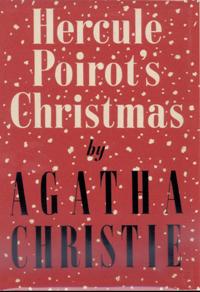
Hercule Poirot's Christmas
You might not expect anything from that title - but don't be fooled. This is a bloody and fiendish locked room mystery, involving - naturally, for the time of year - a family who hate each other! This theme of bickering relatives is done many a time, but never as good as this one.
The Hollow
A later one, this - but it's on the list because it's very well written. At a weekend in a country house, a doctor is found shot in the swimming pool... Poirot has to sort through tangled relationships and a wealth of baffling evidence to catch the murderer...
Taken at the Flood
Another late one, which took me by surprise - and I've tried to come up with a range here. Whilst many themes are common, this one is set in the shadow of the Blitz and the War (something rarely acknowledged in these books, especially during the War itself, rightfully), and it has a thrilling solution. A young girl has found herself a widow and, much to the anger of the rest of the family, inheritor of a large fortune. But when a man arrives claiming that her marriage was invalid, things come to a head...
Also of note - because I'm restricting myself to only a few! - Five Little Pigs, Lord Edgware Dies, Peril at End House, Three Act Tragedy, etc, etc...
The Miss Marple novels
There's less of these ones, but she's still very popular. Whereas Hercule Poirot is a bossy private detective, Miss Marple is the opposite: a village spinster, with an equal eye on human nature! Perhaps it's this charming side of her character, and the stories themselves, that have made these so popular.

Murder at the Vicarage
This one's the first Marple, and probably the most famous. What I love about it is the characters. Whilst the murder and solution itself isn't one of Christie's best, the story is a real treat, as is the humour and liveliness of St Mary Mead. (And also, like so many others, the TV movie has a fab cast!)

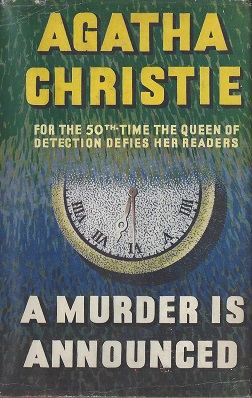
A Murder is Announced
Probably the most enjoyable Marple there is. Not only have you got the village life that made the above so wonderful (also the setting for quite a few of these - not enough of them, I say), but also a gripping whodunit. When an advert in the local newspaper says a murder will take place at a local house, everybody is puzzled... until the hour comes, and a body appears! Very well written.
A Pocket Full of Rye
With this one, I saw it on the telly first, which made the book rather a chore. Which was a shame - as it's rather fine. Christie bases a few stories around nursery rhymes, but this one's rather more blatant (and therefore, surreal!) as there's suspicious murders involving a businessman, his wife and the maid...
Also of note: The Body in the Library, The Moving Finger, The Mirror Crack'd from Side to Side.
The rest
It feels a bit wrong to sideline everything else into one category - here you have other returning characters, as well as stories with no detectives in them at all. Exotic thrillers, psychological dramas, crazy politics and spies...
And Then There Were None
The pinnacle. And her best selling novel, with good reason. The plot - ten people are invited to an abandoned island, but each of them has a secret past. When the island becomes cut off, and people start getting murdered, it is evident that one of them must be a homicidal maniac... A very suspenseful, utterly gripping story, the basis for which has been used many times since. And it's not as contrived as I've made it sound, honest.

The Secret Adversary
This book deserves a mention, as it's the best out of the five that star Tommy and Tuppence, a pair of young investigators who get imbroiled into a political mystery. Uniquely, they age the same rate as the books - unlike Miss Marple, who's a pensioner for about fifty years, they grow old together, whilst still having adventures naturally! In this one, they're up against an international spy ring in a pretty barmy, but well written and lively thriller.
Towards Zero
Probably the only 'proper' murder mystery on this last list. It could take pride of place in any Poirot or Marple collection, but instead features Superintendant Battle (who features in a few books, including Avengers style crossover Cards on the Table) - and he's not in it too much. A tennis player turns up to a seaside party, and where both his wife and ex-wife are staying. And then their host is murdered...
Death Comes as the End
Agatha wrote some odd books in her time (I particularly like the bonkers conspiracy thriller Destination Unknown, and there's also the baffling James Bond style The Big Four) but this one shows real flair. Whilst a few books are set around archeological sites, and in far eastern places, this goes one further... it's a murder mystery set in ancient Egypt! It works far better than you think, and contains all the usual charactering and intrigue.
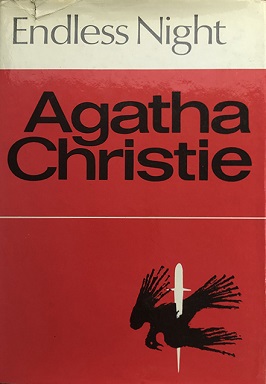
Endless Night
A very late book, but very well written. It's told through the first person of a young man who falls in love, but dark events follow...
Also of note: Crooked House, Ordeal by Innocence.
So that's that - a quick guide to the best of the best of Agatha Christie. Of course, by this list I'm not saying the rest of the books are bad (well, not all of them, at least!). I'd advise any new readers to check them out, though. I know I've read eighty-odd, but I love her work to bits.
Coming soon: a (much briefer) guide to her short stories.
So in this post, I'm going to guide you through the highlights and highpoints - mostly the classics you might have heard of, but they're classics for good reason. This is probably a list of some of the best things she's written - unlike Sherlock Holmes, say, her novels are far better than the short stories.
The novels broadly divide themselves into three categories - the ones starring Poirot, the Miss Marple mysteries - her two most prolific detectives - and the 'other' category, of which there are many. Not all of these are murder mysteries - there's also some brilliant thrillers, as well as delving into the romantic and supernatural,
A word of advice if you're picking books off the shelf - broadly speaking, 'vintage' Christie tends to be stories written around 1930 (her early twenties work take a while to hit their peak) to 1950 (in the novels of the late 60s and into the 70s, written in the last years of her life, the standard of writing and plotting has noticeably slipped). And if you remember the TV (or film) adaptations beforehand then, in most cases, don't bother reading! Honestly, you'll enjoy them far, far more if you don't know what's going to happen next.
The Hercule Poirot novels
In my opinion, the best of the bunch - I prefer Poirot stories to Marple, if only because they contain some of her most ingenious set-ups. Poirot was the first detective she came up with - and, together with friend and narrator Captain Hastings - is basically Sherlock Holmes... but Belgian! Whilst early stories deal with many Holmesian ideas - Inspector Japp takes on the beleagured police role, there's a wife for Hastings, even an Irene Adler figure - he soon grows out of his trappings into something much greater. So - which are my favourites?
The Mysterious Affair at Styles
Her first novel, written as a bet, and designed to be surprising and unsolvable, yet all the clues are before us. You could do a lot worse than this, a fine country house mystery. (Poirot returns to the house of Styles in his last (chronologically) story, 'Curtain'. But that's a whole other novel.)
Controversial, ingenious, and probably not the best choice for a first dip into Christie - although it is one of her very best. I'll say no more!
Infamous, especially the ending - but if, like me, you don't know who did it, it's a perfect chance to dip into Poirot's most famous adventure. There's lots of atmosphere created by the isolated setting of the train, and the investigation is methodical and ever intriguing...
The ABC Murders
Another downright classic, probably my absolute favourite Poirot - if only because it's such a different style to the others. A serial killer is working his way up and down the country, and through the alphabet, going from Andover to Bexhill, to Churston... thrilling and satisfying!
A slightly contrived, but enjoyable murder here - four criminals playing bridge, and any one of them could have killed the man in the corner whilst they played... With a very narrow list of suspects, and hardly any evidence, this takes a more psychological approach, but is handled very well indeed. And of course, I must mention one of Agatha's most delightful creations: Mrs Ariadne Oliver, a writer of murder mysteries who provides a comedic counterpoint to Poirot on many later occasions.
Death on the Nile
Solid - that's the word I'd use. Whilst most of the books on this list are utterly ingenious, this one ties everything up rather most succinctly than most, and provides clues and suspects galore, which is probably why it's so popular. On a gloriously exotic and expensive river cruise in Egypt, passions come to a head, and a wealthy heiress is murdered...
The Hollow
Taken at the Flood
Another late one, which took me by surprise - and I've tried to come up with a range here. Whilst many themes are common, this one is set in the shadow of the Blitz and the War (something rarely acknowledged in these books, especially during the War itself, rightfully), and it has a thrilling solution. A young girl has found herself a widow and, much to the anger of the rest of the family, inheritor of a large fortune. But when a man arrives claiming that her marriage was invalid, things come to a head...
Also of note - because I'm restricting myself to only a few! - Five Little Pigs, Lord Edgware Dies, Peril at End House, Three Act Tragedy, etc, etc...
The Miss Marple novels
There's less of these ones, but she's still very popular. Whereas Hercule Poirot is a bossy private detective, Miss Marple is the opposite: a village spinster, with an equal eye on human nature! Perhaps it's this charming side of her character, and the stories themselves, that have made these so popular.
Murder at the Vicarage
This one's the first Marple, and probably the most famous. What I love about it is the characters. Whilst the murder and solution itself isn't one of Christie's best, the story is a real treat, as is the humour and liveliness of St Mary Mead. (And also, like so many others, the TV movie has a fab cast!)
A Murder is Announced
A Pocket Full of Rye
With this one, I saw it on the telly first, which made the book rather a chore. Which was a shame - as it's rather fine. Christie bases a few stories around nursery rhymes, but this one's rather more blatant (and therefore, surreal!) as there's suspicious murders involving a businessman, his wife and the maid...
Also of note: The Body in the Library, The Moving Finger, The Mirror Crack'd from Side to Side.
The rest
It feels a bit wrong to sideline everything else into one category - here you have other returning characters, as well as stories with no detectives in them at all. Exotic thrillers, psychological dramas, crazy politics and spies...
And Then There Were None
The pinnacle. And her best selling novel, with good reason. The plot - ten people are invited to an abandoned island, but each of them has a secret past. When the island becomes cut off, and people start getting murdered, it is evident that one of them must be a homicidal maniac... A very suspenseful, utterly gripping story, the basis for which has been used many times since. And it's not as contrived as I've made it sound, honest.
The Secret Adversary
Towards Zero
Agatha wrote some odd books in her time (I particularly like the bonkers conspiracy thriller Destination Unknown, and there's also the baffling James Bond style The Big Four) but this one shows real flair. Whilst a few books are set around archeological sites, and in far eastern places, this goes one further... it's a murder mystery set in ancient Egypt! It works far better than you think, and contains all the usual charactering and intrigue.
Endless Night
A very late book, but very well written. It's told through the first person of a young man who falls in love, but dark events follow...
Also of note: Crooked House, Ordeal by Innocence.
So that's that - a quick guide to the best of the best of Agatha Christie. Of course, by this list I'm not saying the rest of the books are bad (well, not all of them, at least!). I'd advise any new readers to check them out, though. I know I've read eighty-odd, but I love her work to bits.
Coming soon: a (much briefer) guide to her short stories.
Labels:
a guide to stuff,
agatha christie,
almost a review,
books
15 Oct 2012
Agatha Christie's "Absent in the Spring"
Another Mary Westmacott - so I thought I'd blog about it. (I could make a habit of this!)
As ever, it's an emotionally engaging book - the contemporary review on the back compared it to Brief Encounter! - and, surprisingly considering the last one I read, fairly short.
Absent in the Spring was written in 1944 - ten years since her last book published under the name Mary Westmacott. It's a sizeable gap in a long career - inbetween she's done stage plays and many novels, including classics like The ABC Murders, Death on the Nile and the sublime And Then There Were None.
And she's also worked on her writing style. The book is written in a third-person narrative, but centred around a single main character and her reminiscences. A 'thoughts-and-all' approach, you could say. It's uncommon, but not unique - it brings to mind similar passages of a woman in the dock in Sad Cypress (1940) and perhaps Endless Night (1967 - although that's in the first person).
But perhaps it links in nicely with a lot of her novels, particularly the later ones - it focuses on memory. When Joan, a fifty-ish year old woman, gets stranded when travelling back from Baghdad (a place Christie was fond of - having based at least three of her novels around Iraq, some with an archeological flavour), she finds herself all alone, with little to do but to think about her life and to find her character.
The book is, basically, a character study - something Christie's very good at when she gets it right. And she does here. It's easy to relate and to imagine the middle-class wife and mother Joan, blind to her selfishness and her overprotective nature with regards to her children and her husband, the lawyer Rodney. (Personally, I "cast" in my mind Penelope Keith, and Paul Eddington in The Good Life - the comparison is quite a good one, and shows how familiar the characters seem!)
The stranded-in-the-East setting is, for the most part, merely window dressing, the icing on a surprisingly moreish cake. It's quite a readable and engaging book - what could seem like a very meandering, random series of flashbacks builds up into a jigsaw puzzle of the woman's life. Each character has a lot of room to grow, despite many never truly appearing - her grown-up children, the placated husband, a schoolfriend who's lived a completely different life. And just when you get tired of the format, there's a change - and she starts to see the bigger picture. All the scenes we've seen, with half-heard or ambigious lines - some of the more obvious than others - she finally gets what people see in her. It's a character study, but one coming from the outside world, and one sketched from qualities that she lacks, more than those she has.
Agatha Christie may be good at characters, but she's also good at plotting, and giving clues. Despite no crime being involved here, there's a lot of clues - the whole thing is, considering what little we know when both we and Joan start this journey. But a coherent plot? Luckily, Christie rescues it in an all-too-brief coda, as she finally gets home to see her family. But given what she now knows about herself, will she change for the better? It's a satisfying ending for a novel that, yes, is actually quite emotionally affecting.
The author's said that this novel felt satisfying to write - in three days hurried typing apparently! - but also written sincerely. As a reader and a reviewer, I can only agree.
7 Oct 2012
Agatha Christie - 'Giant's Bread'
As you may or may not know, over the past three or four years, I've been reading the works of Agatha Christie. What started with dipping my toe into detective fiction, by reading the likes of 'Roger Akroyd', 'Death of the Nile' and 'Murder on the Orient Express', became the voracious task of trying to read all 80 odd of her works.
So now, after finally completing that task (well, nearly - I've still got a book of short stories to track down), I'm tackling some of her wider work; namely, the books written under the name of 'Mary Westmacott'.
They're often clubbed together - despite her having written them over the course of about thirty years, and with no common characters. And they're often dubbed 'romantic fiction' - despite there being few happy endings, even without the grisly murders...
So - 'Giant's Bread'. This was her first non-Crime novel, published in 1930, and it's quite an epic, being about double the word length of your standard Christie.
Perhaps unfortunately, I've read her second book, 'Unfinished Portrait', before this one - so I'm picking up on the apparent similarities of the two. But both, bar framing devices at the start, deal with the life and loves of their central character - in this case, Vernon Deyre.
We first meet him as a child, but quickly he grows up into a young man. Too quickly, you could say - as it's this child's perspective that Christie does rather well, dealing with imaginary friends and childhood games, but also topics like adultery, class, and deaths in the family, through a child's eyes. Yet still keeping the characters in focus - this is the rather selfish, troubled Vernon Deyre, not an idealised childhood.
She rightly uses it much more in 'Unfinished Portrait' - in which we see the girl, Celia, go from a young child, having governesses, moving abroad, going to finishing school... Here, there's a sudden jump from between the ages of about ten and twenty - missing out Vernon's schooling in Eton and Cambridge. Similarly later in the book, little is said about fighting in the (albeit fairly recent in the memory) Great War - instead, we're given the full scoop on the everyday life of VAD work. Well, they say write about what you know...
It's easy to see Agatha Christie's mark on these stories - even this one. Anyone who's read her early short stories will know her love of the opera. Here, Vernon is a musical genius, and although he struggles with his art, the composer of avante garde operas. One might say this reflects her own struggles with coming up with new novels (despite this being the start of a particularly fruitful era for her). Despite one or two laboured points - being scared of pianos gets a little bit forced - the musical side of things is done with conviction.
Whilst there's a particularly open ended prologue which doesn't give too much away, sadly the blurb - and many write-ups, do. It's a flaw of the novel that the plot point oft mentioned (being killed in the war, and his wife remarrying) only turns up in the final third of the book. That's not to say it's not good to read - it's mostly a breeze, despite me taking a couple of weeks with it - and not that there's unexpected moments. You're kept guessing at who Vernon will choose to marry - and for what reasons. Will it be his meek cousin Enid? The charmingly pretty Nell? Or the temptress singer Jane? Even though, from Vernon's point of view, it's not about love (or sex - which hardly gets a mention, discreet or otherwise) but about the music.
In terms of characters, you've also got his arty, rebellious cousin (almost sister) Joe, and neighbour-turned-best-friend, the Jewish wealthy Sebastian (who's surely the best choice for Vernon, no?). It's with him that Christie treads a fine line, from a modern perspective. On the one hand, having a main character who's Jewish - one of the strongest and most forefront in her books - is perhaps mould-breaking and championing. But on the other, he's a stereotype, down to the descriptions of yellow faces and loving of money, and a host of anti-Semetic remarks from other characters. But in the end, he's a stereotype with a heart, and a proper character of his own, so maybe it is a success.
Overall, it's a long meandering book, but as readable as most Christies happily are. There's some memorable characters, and a quite pessimistic tone - and whilst the ending isn't quite as fulfilling given the rest of the book, it's a good 'first' novel from the enigmatic Ms Westmacott.
Subscribe to:
Posts (Atom)