Showing posts with label a mystery. Show all posts

5 Jun 2014

Hangman's Holiday by Dorothy L Sayers

I seem unable to find the attention span to read a full length novel at the moment (even on holiday!) - so handily I've got this collection of short stories by Dorothy L Sayers (not to be confused with the very similar sounding Busman's Honeymoon!). There's twelve stories, quite short, some with Lord Peter Wimsey, some with Montague Egg, a travelling salesman, and some without a detective.

Alas, this book is a bit unsatisfying. Short story collections are inevitably a mixed bag, and this is no exception.


Let's start with the Peter Wimsey stories - Sayers's most familiar creation, and these stories are longer than the others in this collection. What went wrong here then?
The Image in the Mirror, the first tale, is admittedly well told - most of it a monologue from a stricken man telling Wimsey how he thinks he's going mad and committing murders in his sleep. It's full of detail and is entertaining, but it's spoilt by the ending - almost as preposterous as the man's own explanation of being 'sent into the fourth dimension', but also incredibly guessable from the opening pages - even Wimsey says so, acting thoroughly bored of his own story by the explanation.
The Elopement of Peter Wimsey is very odd - Wimsey doesn't feature at the start, which is more like an MR James pastiche. The second half, as Wimsey changes tack suddenly, not just jarring but very silly. Whatever humour is might have had has been lost by time, and it feels like a waste of pages with too much scene setting.
These first two detective stories are very different to usual, so perhaps it's noble of Sayers to be exploring the possibilities of the genre. The rest of the book is more straightforward. Sadly The Queen's Square, which consists of about twenty pages of the movements of guests leading up to a murder, is infuriating. It's all just names rather than any fleshing out of the characters of the suspects (even though there must be over twenty of them!), and is impossible to follow, let alone guess the very scientific explanation. The Necklace of Pearls fares much better: although characters are still mere sketches on a page, at least it's enjoyable (set at Christmas, a time Sayers apparently hated, and you can tell!).

Onto the Montague Egg stories, then. I approached them with a heavy heart, especially seeing these stories were shorter than the rest. But as a whole, they remind me of the Poirot short stories (or similarly Christie's Parker Pyne or Harley Quinn tales) - nicely uniform in style even if they deal with exotic locations, and the perfect story for this length. There's enough variety to keep you interested too - you've got courtoom drama, identifying a murderer, murder in Oxford, and a missing person - and also a very odd story about cats that has a rather sadistic and sour end. None of them are anything special, but most are satisfying and good to read.
Montague Egg himself is defined almost solely by his profession - he's a travelling wine salesman, eager to please, impossibly sharp eyed, who just happens to come into contact with mysteries and crime! It's a very sketchy character, but it means he's very suited to short stories rather than novels.

The final two stories are thankfully the best. The first, The Man Who Knew How, has a man chasing up suspicious deaths after a chance encounter, with a twist in the tale.
And then there's the enjoyable The Fountain Plays, which dispenses of a detective and instead focuses on the actions of a murderer trying to second guess the police. They're the sort of clever stories that Hitchcock would adapt into films, or would feature as an episode of The Twilight Zone. In particular, neither of them feature acres of detail and suspects, and are all the better for it.

In summary - these stories feel different to what's typically referred to as Dorothy L Sayers's style. Her novels are full of details, in both character and atmosphere, and often eccentric. In the confines of a short story, most of that is stripped back to reveal clever solutions (almost more tricksy and involved than the explanations in her novels!) I get a sense of the writer trying to work out what stories she can tell in this format, the level in quality explained by the stories being collected over, presumably, a number of years. As a collected work, it's not the best book ever, nor is it very memorable, but you should find things in it to enjoy.

14 May 2014

'Murder Must Advertise' by Dorothy L Sayers

A short review of this classic 30s mystery - and the first Sir Peter Wimsey book I've read. Dorothy L Sayers's books regularly show up on lists of the best detective fiction (the Crime Writers Association put her up with Sir Arthur Conan Doyle, Dame Agatha Christie, or Raymond Chandler). But like the rest, there's no clear consensus on her best novel. The Nine Tailors (on my reading list) and Gaudy Night and Strong Poison (two with Harriet Vane assisting Wimsey) are often cited, along with this one.


Set in an advertising agency, Peter Wimsey goes undercover in order to investigate a suspicious death and a drugs plot. Dorothy L Sayers has had considerable knowledge working as a copywriter - and it shows. The atmosphere in the opening chapters (and all the way through the book actually) conjures up a lively workplace of people - most of them thinking up the advertising slogans and campaigns in order to flog unnecessary stuff to the public. She captures the madness of the job with a satirical eye, and it gives the book an edge. The characters are reasonable, and there's lots and lots of them. A pleasing range in female characters, and of men too, but often the workers are interchangeable, and it's hard to pick out somebody in particular as a suspect - nor, do I suspect, does the author want to either.

I've heard that, like this one, Sayers's books focus more on the background and characters than constructing a clever, potentially dry murder mystery. Actually, the crime is quite well thought out, but there's not enough of it to cover 100 thousand words. That's not to say it's boring or that it drags along: there's plenty of ingenious chapters and set-pieces (workplace arguments, some skulking around town, some slight but colourful party scenes, a lengthy cricket match near the end that might confuse people who didn't know the rules).

It might be the first book of hers I've read, but I'm not a stranger to Wimsey - there was a short section with him written by another author in an anthology (to which she also contributed), and I've listened to one of the (3 hour odd) radio adaptations, of her first book 'Whose Body?'. That one was mad - a rambling mystery with little twist in the murderer's identity. The blurb on my edition of Murder Must Advertise says that 'five people will die' - and bar the first murder before the book begins, all of these happen in the last third of the book, and most are forgettable. By the climax, the whole thing is downplayed, with most of Wimsey's conclusions explained beforehand. I was surprised by the 'drug plot' - it sounds a lazy enemy to be up against (police unable to catch them, members potentially everywhere), but it's handled with enough detail to be plausible.

I found the book a great read, with a great setting and plenty of interesting diversions too. So it surprised me to read that the author herself didn't think much of it, that it was apparently written in haste to satisfy her publishers, before she could work on her next book with her preferred setting, the chuch bell-ringing of The Nine Tailors. Will that book hold up against the hype?

4 Apr 2014

Detection Club: The Floating Admiral / Ask a Policeman

A couple of years ago, in my quest reading all of Agatha Christie's work, I stumbled upon a recent reprint of an old collaborative book. Written in 1931, The Floating Admiral was devised by the members of The Detection Club, a 'fun' society whose members included the likes of Agatha, Dorothy L Sayers, GK Chesterton and many many others since. Presumably the reprint was a success as now a second Detection Club novel has been reprinted by HarperCollins, and I've just finished it.


The Floating Admiral was one of the first published collaborations between a group of professional, published authors, and even today it's quite star studded. There's fourteen writers involved, writing a chapter of a detective story each. Naturally, the story suffers - you can't compare it to a typical crime tale, even if the plot has all the hallmarks of one. A body is found murdered, floating on a boat on a river mouth between two towns! Not only is there suspects and alibis and tracing his movements, but also remarks about the tide and how to moor boats!
The style jumps around with each author, especially with the addition of more clues and twists, but it's kept from getting too contrived by an ingenious instruction: each writer, as well as acknowledging everything that came up before, had to come up with a solution to their chapter (printed at the end of the story), their own explanation of the evidence. Agatha Christie, whose short chapter thankfully has a lot of typically good dialogue between characters, came up with a famously great explanation, which I won't spoil here.

It's a very interesting book, and a fun experiment for the Club (they had worked together on a couple of short serialisations before this, but not a full length novel). Many of the writers have faded into obscurity (especially the most florid named such as Canon Victor Whitechurch and Edgar Jepson), so the introduction putting them into context is much needed. The book itself, though, is an odd read. What starts off as atmospheric and scene setting, quickly descends into a mess of overly complex evidence, deduction and counter deduction. The task of the final writer to tie everything up must have been enormous - but I'd prefer something less technical, playing on the fact each chapter has a different author by having a change in style, rather than juggling the plot all of the time. It's skilfully written though, definitely grabbing your attention, and definitely living up to the concept.


Ask a Policeman, the following collaboration, seems to tackle the inherent problems of the first book head on. For starters, it has only half the number of authors than the first book, making it a smoother, slightly more coherent affair. And secondly, this time they bring along their detectives!

The four detectives were probably well known to readers of detective fiction in 1934, but less so now. Whilst I'm familiar with the enthusiastic (and often infuriating) Lord Peter Wimsey from Dorothy L Sayers, and I've heard of Gladys Mitchell's Mrs Bradley (played by Diana Rigg later on TV, and I've got one on my reading pile), the other two I hadn't heard of before. The trouble is that these books are barely in print at the moment, especially Helen Simpson's stage manager Sir John Samaurez and Anthony Berkeley's Roger Sheringham, who, whilst having books adapted into films by Hitchcock (!), remain obscure. Not to mention the other two authors involved in this (and the previous book too), John Rhode and Milward Kennedy. This means it's sometimes hard to see the humour and parody involved when they appear, but they're good characters and very good writers.
In fact, the book itself is marketed under Agatha Christie - and unlike The Floating Admiral, she hasn't even contributed to this one! Rather, they've lumped in a Preface that was published elsewhere, an essay by her about other Detective Fiction writers. However it's a great piece - insightful and critical - and fits this book very well.

It's rather a shame that some of the writers aren't better known, because it's a good read! This book has an odd gimmick - one writer, Rhode, writes the set-up this time, putting in an impossible amount of clues into his relatively short opening. That it stands up to the later repeated scrutiny, and doesn't get too dull when it's explained again and again, shows his merits. (The plot itself is possibly stereotypical, and definitely contrived, with three important pillars of society being involved and suspected in a country house shooting!). Whilst it's all about alibis and timings, the initial chapter is so open, the following chapters are all quite different.
The next four writers each have detectives 'solve' the case - but in a gimmick designed to invoke parody, they swap detectives and are writing in somebody else's style. This doesn't entirely work without knowledge of the originals, but it's put to the background. More important are the deductions, and there's a lot of them. Whilst some of these are long winded or with overly flowery prose, they're different enough to keep holding your attention, especially in small doses. By the end of it though, you know the movements of everybody at Hursley Lodge like the back of your hand, it's been reiterated and debated so many times.
And then, tying up everything in a very fun and ingenious final chapter is Milward Kennedy. The clever conceit is that all of these detectives, whilst their chapters were written independently, worked around each other, and every clue they found was correct - even if they picked different suspects as the murderer. So who really did it? A fifth solution is found, that's meant to be the 'correct' one that fits almost all of the evidence. It sounds horrendous to write, making sense of every clue (and sneakily discounting a couple of murderer's confessions!) but thankfully it's painless to read.

Both of the books are less coherent and less readable than usual detective novels, but then they don't claim to be. Rather, through parody and wit, they enthusiastically push some of the conventions of the genre, in an era where detective fiction was all the rage. These books are better than the concept sounds, and well worth discovering now they've been reprinted once more (in very smart new editions!), and the talent involved means they shouldn't be overlooked in a hurry. Whether any more of the few Detection Club collaborations will be republished, without Agatha Christie's name attached, remains to be seen, but I hope so, if they match this standard.

17 Apr 2013

The obligatory Broadchurch post

Six weeks ago, the first part of Broadchurch aired - a slow, Dorset-set drama about a crime that shocks a small village. Since then it has slowly and surely built up to what some people are tipping the telly drama event of the year (well, so far at any rate). Certainly it's a big hit ratings-wise.

It's amazingly well made, which is odd because it's an ITV drama - great cast, lovely stylish direction and music, and even the writing's up to scratch. One of its strengths is in its sincerity. Not only is there realism in the local police's investigation, but you've also got Olivia Colman in it, and she's amazing, which adds some warmth and humour and truthfulness to the subject material. Given the slow pace - seven or eight weeks is a long time in this digital age - and that it's dealing with heightened events, it's the characters and the humanity that stops the whole thing getting silly.

Many people have compared it to Danish drama The Killing and you can see why: a (relatively) long, drawn out investigation isn't the norm on crime dramas these days - usually it's wrapped up in two hours. It takes its time with the potential suspects (an isolated community, with huge murder mystery style potential suspicions), and we see the story, mainly, from the point of view of the police, the victim's family, and the press. Like The Killing, it's quietly stylish (although this has much more slow-mo), but also it's very gripping, with a new development and twist seemingly every week. The cliffhangers might not match The Killing's - though Episode 6's nighttime chase could have been lifted from the other - but it's proving to be unmissable.

Final episode's next week, and we still don't really know who's done it, and a whole heap of forgotten clues and soon-to-be-answered questions.

So - who killed Danny Latimer?


Seeing as everyone's got a pet theory - which everyone then has to change week on week - I thought I might post mine.

First off - the death. It's a bit hazy at the moment - first we see Danny on the cliffs at the dead of night (which nobody's mentioned!), then there's a hut, a boat which was later burned, and the body put on plain view on the beach... So, he was killed on the boat then. Why all the trouble - lack of evidence? Seemingly Danny went to meet his killer secretly that night... willingly? And did they want the body to be found straight away, because they had an alibi that night?

Susan Wright says she saw a man in a boat, dragging the body onto the beach - did she really? She lies easily, as we've seen. And though she recognised the man as Nige - who is now a credible suspect - can we trust her? Could she be the murderer herself? (unlikely)

Danny's friend Tom can't have done it - that would be silly, even if he's acting strangely. Even more silly would be his father, and Ellie's husband, Joe Miller. I know people are speculating it, but he's the least likely person who could have done it, and the only evidence against him would be the stuff with his son. So no - but Tom definitely knows something important, perhaps who Danny was going to meet.

In your standard murder mystery, often it's the most likely person who did it. Here, the most likely person was the first person arrested, Mark Latimer. He got off, as he had an alibi (though it was the first time he'd ever slept around...) and not much of a motive-  but could later evidence change things around? It's not the most likely, but he's still in the picture, and it would bring the story round full circle if it was a big main character like that.

Otherwise, my (figurative) money's probably on the dark horse, psychic Steve. It's a bit of a ludicrous character, but played perfectly down-to-earth. I can see why he's in the show - it ties in with the themes of grief and the public and adds a layer of mystery. But, presuming he isn't a psychic then - how did he know about the boat? He hasn't been in it much, but he's still a suspect too... Don't get me started on motive though!

And then you've also got the nice young vicar with a shady past (who was more trusted than the newspaper seller with a shady past!), and the thing with Danny's sister's boyfriend...

Regardless of what the end result might be, it's still been one of the best things on TV this year. Now we just have to wait until Monday...

6 Apr 2013

The Rings of Akhaten

Odd title, that one.


I thought I'd write something longer about this week's Doctor Who, given the general split in people's initial opinion. So:

It's always going to be an uphill struggle, doing an alien story like this. Building a culture, making it look the part, finding something to connect to - and I thought it worked. Having a bunch of random aliens in the marketplace may be a bit Star Wars, but it draws you in (even if I was playing 'spot the reused bits of alien'). It even makes you forget most of the episode is done in a studio. As to the culture - the idea behind the religion not only felt original and emotional, but also gave the story a plot (and a monster) that was a twist on the usual.

There's a lot of green-screen, which works to various degrees - the lowest one being the very ambitious hover moped chase across an asteroid field. But they were trying very hard with that one. But the lovely vistas and alien suns are just pretty distractions - for the acting! It's lovely to finally see Jenna Louise-Coleman in the companion role - the getting-into-trouble role, and actually apart from the Doctor for once. Yes, I know she did similar things with ice monsters and Spoonheads, but it feels right, here. Almost traditional - in a story that tries very hard to be different. And Matt Smith, well - I was thinking he was being marvellous even before he made his speech at the end.

But maybe it's the sign of a dull episode that - when you notice how good the regulars are (which invariably they are, every week!). And for a story that seemed very 'Episode 2', it's like somebody smudged together lots of different Doctor Who tales together - you've got exploding planets and weird freaky aliens (Episode 2 in 2005), mysterious religious cults with alien gods (Episode 2 in 2008), a lost girl that the companion finds (that'll be Episode 2 in 2010), a CGI menace that was held back by reciting in a theatre (well, a bit of a stretch, but it reminded me of the Shakespeare one - though the singing was quite new, if a little out of place).

That's not to say the episode didn't work in its own right, or that it wasn't an exotic slice of adventure. Although I'm not sure where they're going with Clara - whilst it's lovely to see her past, are they trying to make us warm to her, or be fearful of who she might really be...?

5 Mar 2013

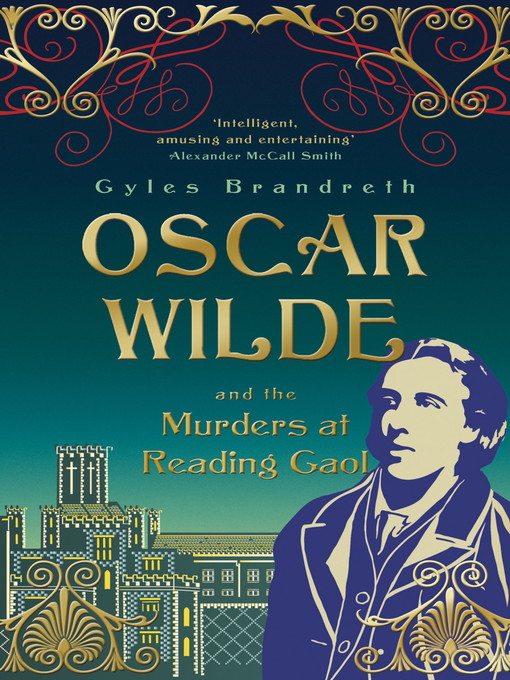
The Oscar Wilde Murder Mysteries


On the 30th August 1889, a very auspicious dinner was held. It was an event to discuss forthcoming material for Lippincott's Monthly Magazine, and among the diners were two of the most acclaimed writers of the forthcoming decade, if not the century. One was Arthur Conan Doyle, who contributed his second novel featuring Sherlock Holmes, 'The Sign of the Four'. In only a few years, Sherlock Holmes would become a household name. As would another writer, but for very different reasons: also attending was Oscar Wilde - the Irish poet, playwright, and personality, later writing 'The Picture of Dorian Gray'.

This meeting provides the incredible conceit behind Gyles Brandreth's ongoing series of novels: what if Oscar Wilde, one of the greatest minds of the age, had investigated murders and crimes, in the style of Sherlock Holmes - together with Conan Doyle (and others) as Watson?

What makes the series far more convincing than you might have first thought, is the level of research. Brandreth - a self confessed Wilde afficiando - plunges you into the time of the 1890s, complete with an array of colourful characters, most of which are real people. Due to Oscar's social standing, he mixes with princes, with acclaimed actresses, and with writers like Bram Stoker - yes, he really did know the man who came to write 'Dracula'. And he captures the vibrant wit and voice of the main character, without reducing him to an endless stream of epigrams and quotes from his plays - at times, delving into Oscar's complex morality and conscience. This grey area chimes well with the dark and shady practices that the books are (entertainingly!) full of - the crimes and corruption that form the 'murder mysteries'.

So far, there are six books in the series - and happily, they can be read in any order. Each is set in a clear place and point in Oscar's life- there's a highly researched picture of London as Oscar would have known it, as well as trips to Italy, and his time spent in Paris, back when he first became famous.

The latest book, published late last year, tackles Oscar's darkest period - the two years of imprisonment, spent in Reading Gaol.
Unlike most of the other books, here there is no Watson figure. It was a time when Oscar found himself cut off from his old way of life, and his old friends, and so rightly it has a very different feel to the rest of the series. Gyles Brandreth takes perhaps a risky approach, by telling the story from Oscar's point of view. He narrates his time spent there, and so we hear of his thoughts and feelings. That this approach is successful, shows what a clear voice the author has shaped throughout the books - that he can get into his mind, and eloquently express the trials and anguish of prison life.

It's a very accomplished book, and like the others in the series, a very good murder mystery indeed. Like the best of them, it keeps you guessing, with a cast of suspicious suspects - although, it's probably best to discount those characters that you know really existed!
In a way, the concrete grounding in fact is the series's weakness. Some of the books feel more researched than others, or having more of a historical basis. They say you should never let the facts get in the way of a good story - although the investigations and murders themselves are fictional (hopefully!), a few of the suspects and cameos are minor celebrities, which can upset the deductive process - where anybody might be the killer!
Nevertheless, there have been a few occasions - including with this book, Oscar Wilde and the Murders at Reading Gaol - just how historically accurate they are. I naively assumed that much of the book, with the inner workings of the prison, with its harsh rules and wardens, were fictionalised, by the author reading between the lines, but no - using detailed accounts from the past, with various documents and testimonies, Gyles Brandreth was able to recreate this dark period of Oscar's life with a high level of detail - that it was so readable does him credit.

 The inside cover of the latest novel provides a final delight - an adaptation of the series could be on the cards, produced with the BBC and also Sprout Pictures, part-owned by a certain Stephen Fry... that would be truly exquisite!

13 Jan 2013

Children's TV - and a plea

I have vast swathes of recollections of things I used to watch when I was younger (not to mention books!). CITV generally ruled, although we did watch some CBBC - and that's aside from the indomitable collection of Disney videos. (Breakfast TV, normally filled with cartoons - although that included Pokemon - was strictly limited to holidays)
When I was younger - Thomas the Tank Engine, Bodger and Badger, Noddy, Old Bear, Sooty, Dennis the Menace, Winnie the Pooh (ohh, great cartoons those were). Probably the greatest show, which definitely stands up to rewatching, The Animals of Farthing Wood, and similarly the perfect Mr Bean. Goosebumps, Sabrina the Teenage Witch, Hey Arnold, hazy memories of the ultra scary Blair-Witch style Jeopardy and Are You Afraid of the Dark. Sunday evening dramas like Aquilla, the oft-mentioned (in my family) Black Hearts in Battersea and The Wolves of Willoughby Chase, The Phoenix and the Carpet, and something involving chocolate. The Worst Witch, The Demon Headmaster - based on the books, with a creepy series about plants and cloning too - Children's Ward (a soap, basically). My Parents are Aliens, Jungle Run, Art Attack, Zzzap!. The original, far inferior, Horrible Histories. And also lots of pretty good shows about computer games - which seems odd now, looking back.

And then there's a drama series, which must have been shown around 2002-2003, which I can't for the life of me track down. And of course, I remember a lot about it - albeit not its strange, weird name that you could hardly pronounce (an acronym, perhaps).
It was presented as a game show or reality show, and had a group of about eight children (who were slightly annoying and bickering) staying in "the world's largest film set". A bit like The Truman Show then - weird things happened each week, shot on 'hidden' cameras, but we were given a glimpse of what was happening behind the scenes - stuntmen and actors and people moving the set around.
I think I missed the first episode (it was on twice a week, Mondays and Tuesdays I think, about 4.30 - I used to scour TV listings even when I was younger), but there was a cake competition I remember, which ended up being poisoned and making the entire town ill, and the villagers angry. In another episode, the group ate some drugged blackberries, and then woke up to find the entire set had been switched to the medieval times, in a sort of time travel adventure. In another, the group stood outside a TV shop, when suddenly aliens attacked (at night - so basically just lights and explosions) and random bystanders were seemingly killed in front of them.
Of course, this made an impression on me - but I can't find anything about it online at all. At the end of the series, the group of children that remained won a prize, a huge money prize (a million dollars?) but couldn't spend it until they were older. It's probably an American or Canadian or Australian show or something, which is why I can't find it.

Around the time of this mysterious show they were syndicating lots of similar dramas from other countries. Pirate Islands was good, set on a virtual tropical island with an over-the-top pirate captain's ship parked nearby. Blake Holsey High looked cool, of a similar style to Buffy, but I only saw the first few episodes. Alongside more home-grown stuff - Sir Gadabout and Harry and the Wrinklies, and odd stuff like Don't Eat the Neighbours.

Later I moved to BBC for some reason - watching Blue Peter for once (though I can't remember many others - though Shoebox Zoo was good, and later things like Trapped!) and then, when I was about 13, Doctor Who would have arrived! And it was long overdue...