Showing posts with label history. Show all posts

5 Mar 2013

The Oscar Wilde Murder Mysteries


On the 30th August 1889, a very auspicious dinner was held. It was an event to discuss forthcoming material for Lippincott's Monthly Magazine, and among the diners were two of the most acclaimed writers of the forthcoming decade, if not the century. One was Arthur Conan Doyle, who contributed his second novel featuring Sherlock Holmes, 'The Sign of the Four'. In only a few years, Sherlock Holmes would become a household name. As would another writer, but for very different reasons: also attending was Oscar Wilde - the Irish poet, playwright, and personality, later writing 'The Picture of Dorian Gray'.

This meeting provides the incredible conceit behind Gyles Brandreth's ongoing series of novels: what if Oscar Wilde, one of the greatest minds of the age, had investigated murders and crimes, in the style of Sherlock Holmes - together with Conan Doyle (and others) as Watson?

What makes the series far more convincing than you might have first thought, is the level of research. Brandreth - a self confessed Wilde afficiando - plunges you into the time of the 1890s, complete with an array of colourful characters, most of which are real people. Due to Oscar's social standing, he mixes with princes, with acclaimed actresses, and with writers like Bram Stoker - yes, he really did know the man who came to write 'Dracula'. And he captures the vibrant wit and voice of the main character, without reducing him to an endless stream of epigrams and quotes from his plays - at times, delving into Oscar's complex morality and conscience. This grey area chimes well with the dark and shady practices that the books are (entertainingly!) full of - the crimes and corruption that form the 'murder mysteries'.

So far, there are six books in the series - and happily, they can be read in any order. Each is set in a clear place and point in Oscar's life- there's a highly researched picture of London as Oscar would have known it, as well as trips to Italy, and his time spent in Paris, back when he first became famous.
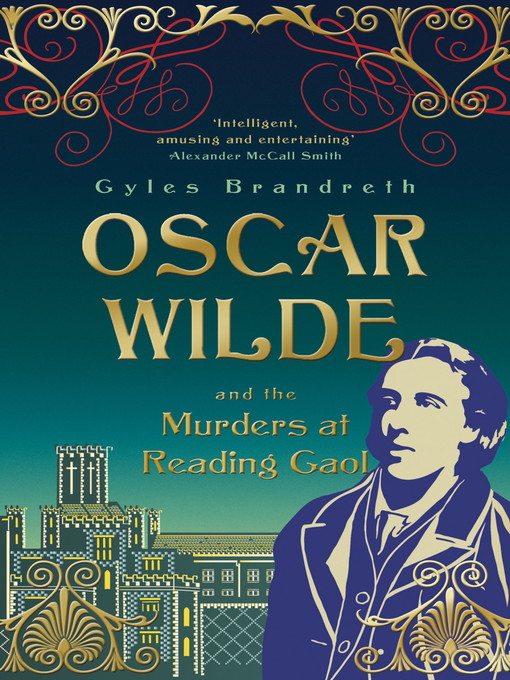
The latest book, published late last year, tackles Oscar's darkest period - the two years of imprisonment, spent in Reading Gaol.
Unlike most of the other books, here there is no Watson figure. It was a time when Oscar found himself cut off from his old way of life, and his old friends, and so rightly it has a very different feel to the rest of the series. Gyles Brandreth takes perhaps a risky approach, by telling the story from Oscar's point of view. He narrates his time spent there, and so we hear of his thoughts and feelings. That this approach is successful, shows what a clear voice the author has shaped throughout the books - that he can get into his mind, and eloquently express the trials and anguish of prison life.

It's a very accomplished book, and like the others in the series, a very good murder mystery indeed. Like the best of them, it keeps you guessing, with a cast of suspicious suspects - although, it's probably best to discount those characters that you know really existed!
In a way, the concrete grounding in fact is the series's weakness. Some of the books feel more researched than others, or having more of a historical basis. They say you should never let the facts get in the way of a good story - although the investigations and murders themselves are fictional (hopefully!), a few of the suspects and cameos are minor celebrities, which can upset the deductive process - where anybody might be the killer!
Nevertheless, there have been a few occasions - including with this book, Oscar Wilde and the Murders at Reading Gaol - just how historically accurate they are. I naively assumed that much of the book, with the inner workings of the prison, with its harsh rules and wardens, were fictionalised, by the author reading between the lines, but no - using detailed accounts from the past, with various documents and testimonies, Gyles Brandreth was able to recreate this dark period of Oscar's life with a high level of detail - that it was so readable does him credit.

 The inside cover of the latest novel provides a final delight - an adaptation of the series could be on the cards, produced with the BBC and also Sprout Pictures, part-owned by a certain Stephen Fry... that would be truly exquisite!

24 Jan 2013

Agatha Christie's Autobiography - a review


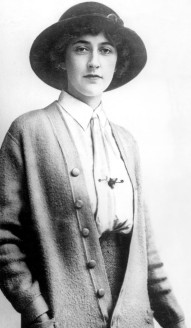
After reading almost all of her canon of work, I've delved into one of Agatha Christie's most important tomes - her autobiography. Though published in the months after her death, it covered her life up to when she was in her seventies, about ten years before she died. Whilst I was reading and discovering her books, I'd built up a strong image of who she was - by what subjects she wrote about, or information regarding the publishing of her books, or that famous disappearance - and even some particularly autobiographical characters she created. So, how would I find reading this, her own, perhaps definitive, account of an eventful life?

The book is a long one - it weighs in at 250,000 words, and took her fifteen years to complete it. But the extra time was worth it, as it's packed full of interesting stories and happenings. And whilst there are digressions along the way, it has all the economy - and excitement - of one of her great books.

People who are expecting a complete guide of every process that goes into writing one of her novels are going to be disappointed - it's an autobiography after all, a personal account of the story of her life. The books rarely feature - and when they do, they're the ones that she considers important personally, or that she has strong memories of, or has picked out as a good book when reading back many years later. There's particularly a fair amount about how she came to write her first book, The Mysterious Affair at Styles, and also the publishing side of things.
It's interesting to read how at first Agatha Christie didn't consider herself as a novel writer, but as a wife who started to do that sort of thing on the side to make some extra money. Ten years on, and she found herself writing books even when she didn't want to - a sign, for her, that it was now a job, and she would write a book every year. There are recollections of crafting some of her early work - the light hearted adventure type thrillers "that are more fun, and quicker to write", yet few of the period in the 1930s in which some of her most acclaimed detective stories were published. However, she also delves into other parts of her work (such as poems, short stories, romantic novels and acclaimed plays) and interestingly, her thoughts on the process of writing, and how she came to do it in the first place. Written in the first person, she shares a lot of personal opinions, and it builds up a picture of her own character - and in one frank section, she simply gives us a list of things she likes and things she doesn't!

That's not to say the life she's lead isn't recognisable as something out of a Christie novel. Plenty of autobiographical detail seems to have been included in her work, sure to be picked up on by those who have read it. Things like travelling on the Orient Express, dig sites in Syria and Iraq, or an exotic business holiday to South Africa, which was then extensively used in the early thriller The Man in the Brown Suit. Much of her childhood seems very close to the Mary Westmacott romantic novels, in which she painted a picture of someone's life story - some things copied word for word - and later novels, like Postern of Fate. But these references are fewer than you'd think - she says she rarely based characters on anybody in real life, certainly not people she knew, and after all - in her eyes, they were purely escapism.
Rather, the avid Agatha Christie reader gets a sense of the time she was living in, and the wider world in which her books were written in - a time of country houses, servants, generations of men becoming soldiers, and unexpected foreign travels. It's easy to forget that some of the events she describes happened over a hundred years ago.

After a slow start, though with many detailed recollections of her early years - no less busy than her later ones, as her parents moved around France as she was growing up - she then covers the events of her reaching adulthood, with plenty of prospective husbands! Personally, I found the book picked up pace, despite the many amusing and heartfelt events of her childhood - and became even more interesting when it went on to cover the events of the First World War, and the interesting world of the VADs, and events that would strongly shape her future.

The book, and by extension her own life, covers a lot of ground - from schooling, to nursing, to travelling round the world - and is often a joy to read. Her books are often praised for their readability, and this one is just the same. Despite the length, it's accessible, enjoyable and moving - giving us an insight into the modest, retiring crime writer, whose audience - including me - previously only knew through her detective novels.

30 Nov 2012

Akhnaton - a play by Agatha Christie

As you might expect from the striking front cover and title, this is something a bit different. In fact, I'd probably never read it if it wasn't for Agatha-Christie-devouring completeness.

It's a historical play (so not a murder mystery) set in Ancient Egypt. It's never been properly performed however (though she must have liked it to want it published), and has 'little commercial value', apparently. Which I read as code for being 'utterly boring'.

But whilst it's not boring, it is a bit dry. You don't need too much background knowledge when reading it - entry level Egyptology will suffice' - but the play concerns the reign of the pharoah Akhnaton (whose wife Neferiti was probably more famous, as was his successor Tutankhamun), and his subsequent downfall. The play wobbles between historical background and research (names of gods, practices, lineage and castes, especially apparent in long speeches) with typical human drama and emotion (idle talk between townsfolk, many of the characters' conversations). It's melodramatic, and more highbrow than your usual fare.

But altogether, it hangs together quite nicely. For its big scale and subject matter (there's many sets and costumes, and always talk of far off rebellion) it wrings every bit of human drama out of the royal court, with the mad king (which felt a bit Shakespearean, but it works), his right-hand-man, and plots against him by priests and saboteurs. He was the king who shook off using multiple religious gods, instead reverting to one, represented by the sun. Agatha paints him as young, artistic and peace loving, ambitious but weak and misguided, and ultimately very very mad. So that's fairly hard to warm to, when your main character goes off on one at the end of the scene.

Whilst it's nowhere near the usual Agatha Christie in subject matter (despite her referring to history and archaeology many times), somehow in places characters end up talking very much like Agatha Christie characters, circa 1937 when it was written (seriously, the discussions about the nature of art could come straight from Five Little Pigs or The Hollow).

Its main feat is creating an actual readable (or performable) play out of such a sparse, yet rich, strain of history. It's worth noting that, as it was written in 1937, much of the historical 'accuracy' has been disproved by now, or even by 1973 when the book was published. It was only written fifteen years after Howard Carter discovered Tutankhamun's tomb. However, given the historically dry subject matter, to experts and non-experts alike, her later Ancient Egyptian murder mystery Death Comes As The End is probably a safer, more mainstream choice.